Showing posts with label Family Memory. Show all posts

January 07, 2024

Cutting The Cord


Cutting The Cord 
By John R. Greenwood 

Dad, I apologize, but I had to do it; it was time. I sure hope you’re looking down right now and nodding your head in agreement. I finally retired your favorite heavy-duty lead cord that you used for work. My first recollection of it as a kid was seeing it coiled up and lying on top of your toolbox in the back of our old International Scout. That yellow lead logged many miles and showed up ready for work at hundreds of job sites all over the Capital District and beyond. I’ll bet it even rode with you to the top of Gore Mountain when installing those giant windows in the ski lodge. That lead and your electric drill helped put food on the table and a roof over our heads long before battery-powered tools were invented. 

I remember the day you passed it on to me. We cleaned out your workshop just before you and Mom moved into the senior apartments. While mom was whittling down her collection of Farberware, you were thinning down your lifetime collection of hand tools and hardware. I went on to use that lead for years. One day, I decided to add a four-foot fluorescent shop light above a dark corner in the basement. The only outlet was several feet away, so I enlisted your fifty-foot lead as a temporary fix, hung it on the floor joists, and then wrapped the excess around a couple of 16-penny nails. That part-time assignment lasted twenty years until the other day when I finally installed a junction box and ran fifteen feet of wire to a new LED shop light. 

Your old work partner was tired and brittle. He served us both well. I never took that fifty feet of yellow for granted. Whenever I looked at that thing hanging there, I thought of the care you took with your tools. That lead represented your thirty years as a union glazier split between Arrow Glass in Schenectady and Spa Glass in Saratoga Springs. How proud you were that in all those years working with storefront-size glass, no one working with you was ever hurt. With that thought in mind, I knew the right thing to do was retire that old lead before something terrible happened. 

I pulled the lead from the scrap bin the next day and cut off the two ends. I plugged them together and stapled them to a post in my workshop. They are a constant reminder of your work ethic and the pride you put into every job you ever did. Your calloused and scarred hands were a testament to the wear and tear it takes to make a blue-collar living. I’m forever grateful that you passed those traits on to me. I do my best anyway. 

Dad, I’ll end this piece with something that makes me smile and think of you several times a week. Whenever you and I were doing something together, and a jackknife was the tool of choice, you would look at me with that raised eyebrow, tilted head look a father gives his son when he’s sure he already knows the answer. 

“Do you have a jackknife on you?” 

“Is it sharp?” 

The answer was seldom yes and yes. 

I sure do miss those days…


December 25, 2021

Bury The Skunk
By John R. Greenwood 

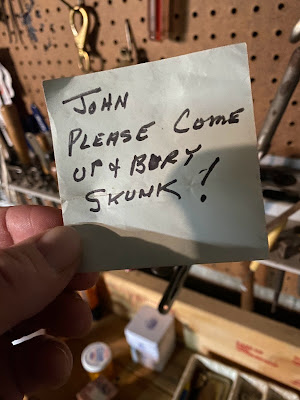
Bury the skunk is not a title you’d normally attach to a nostalgic Christmas story, but then again, normal is a word that doesn’t seem to fit anything these days. Using Christmas story to describe it is also a stretch. A better explanation is that I found this little note just a few days before Christmas 2021. I was straightening up my tool bench when I opened an old tobacco tin filled with my father’s memorabilia. The note above was folded in half and tucked in the bottom. As I unfolded it I was reminded of the day I found it under my windshield wiper at work. I had probably just returned from a twelve hour day delivering a tractor trailer full of Stewart’s product somewhere in the far reaches of New York State. I was in my forties and probably looking like they say, “rode hard and put away wet.” Dad’s health was not great at the time. He could still drive and mow the lawn on his John Deere riding mower, but digging a hole to bury a deceased yard-skunk was not something he could manage. By this point in his life he’d  realized some tasks were best left to his dutiful son. By this point in my life, I’d realized it wasn’t worth questioning dad’s requests, you simply nodded and complied. That roof over my head for the first eighteen years didn’t pay for itself. 

I don’t remember the details of the skunks demise or the funeral proceedings, but I do remember why I saved this little scrap of paper. I saved it for moments like this. Those little pauses in life where you reflect on all the tiny scraps that combined to make a life worth living. The simple joys, the tearful losses, the cherished memories that weaved a giant patchwork quilt bursting with good people and laughter. The pauses you hold dear to your heart. The ‘bury the skunk’ notes and the Pharaoh Lake fishing trips. I miss my parents. I even miss the not-so-great times that were mixed in the middle. Those are the ones that help you embrace the isn’t-life-grand moments.

I’ve been a lucky man. My Christmas shows up 24/7/365 in all shapes and sizes. As I placed dad’s little note back in the bottom of the tobacco tin I realized that sometimes burying a skunk can smell like a bed of roses.

Merry Christmas.
May your 2022 be filled with notes of joy!


November 05, 2020

Cover-Up (A Greenfield Memory)

Cover-Up (A Greenfield Memory)

By John R. Greenwood 


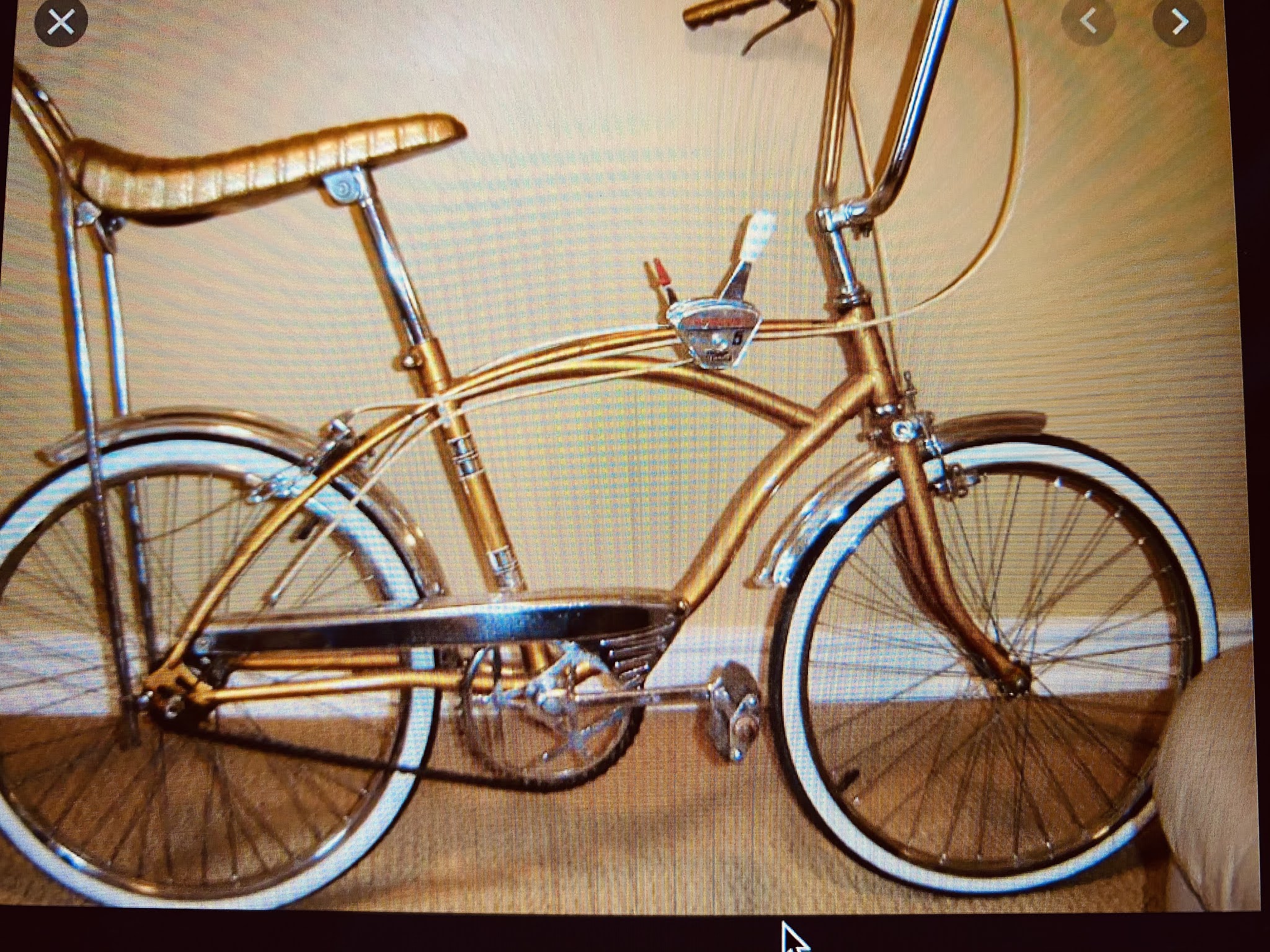
I want to share a father/son moment that took place in 1968. I was thirteen and had saved enough money for a new bicycle. I bought my Raleigh Rodeo 3+2 at Globe Supply(presently Soave Faire) on Broadway in Saratoga Springs. It was a stingray bike styled like the muscle cars of that era. It had a Hurst-like, 3-speed shifter on the frame in front of the seat. Next to it was a smaller shift knob, which gave you two more pedaling speeds. It was gold in color and my pride and joy. I parked it on its kickstand every night in the garage. Saturday mornings, while dad washed our International Scout, I would wash my Raleigh next to him.


My father instilled the importance of taking care of your things. The better the care, the longer they will last. I came up short a few times because I remember being on the receiving end of "That Look" after I misplaced or broke one of his tools. Parents hope that if a child buys something with their own money, they will take better care of it. Hope is just that. The chances of your child having the conscientious-trait is a crapshoot. Some get it; some don't. Most kids fall somewhere in between. I probably leaned more to the caring side because I feared "That Look" worse than a kick in the shins. 


In the 1960s, it was popular to ride your friends on the handlebars. They would rest their feet precariously on the small bit of threaded axle sticking out from the front tire. The other option was to let your legs swing free, which was much more difficult for both rider and the one pedaling the bike. It was also an excellent way to get run over by a car. My father was adamant that I do not try this with my bike or with anyone else's. I was a compliant son, and I was also much too afraid of my father to break that rule—that is until Glen came along. Glen was older, bigger, and wanted to get from point A to point B one day. He insisted that I provide a taxi service from the Greenfield General store to his friend Tom's house at the bottom of Cemetery Hill about a quarter-mile away. Glen was the Eddy Haskell of our neighborhood. He was an instigator and possessed a larger than life personality. He was the type of kid that could get you in trouble quicker than a wink, but at the same time, his presence helped you remember those events with overwhelming fondness. On this particular summer day in 1968, everything above fell into place.


Because Glen was too big to ride on my handlebars, he strong-armed me into the role of hood ornament. Boys at thirteen are about as coordinated as a giraffe on skates, and I was no exception. A few hundred feet up the road, my sneakers slipped off the axle bolts, and my toes got caught in the spokes. Glen, the Raleigh Rodeo, and I went ass over tea kettle. When the dust settled, a friendship and a brand new bike were in a bit of a pickle. I remember having to push my bike a mile back to my house, the whole time thinking about how mad my father was going to be. He would be upset about the bike, but even more so because I disobeyed him. The front wheel was a bent mess. The spokes had a pretzel quality to them. 


What do I do? 


You do what any red-blooded thirteen-year-old would do—cover it up! This virtual cover-up included an old blanket. Like a reprieve from the governor, it would buy me time to devise a brilliant scheme. The words "brilliant scheme" and "teenager" mix like oil and water. It did take a couple of days for my father to decipher why I was walking the mile up the road to the village versus riding my brand new $70 bike. Fathers are more observant than we think. My teenage sons learned this factoid about the same time their father did. 


"Why is there a blanket over your bicycle?"


Here's where you begin to weigh your options heavily. I didn't have enough time to concoct a viable lie. Even if I had (my wife will confirm this), I'm a terrible liar—especially if she or my father are involved. It was time to plead for mercy. 


"Um, I, I, well, uh, I messed up." (add tears here) 


Here's where parenthood takes a moment of silence. It's a silence that doesn't pay dividends until your grown children recognize the honesty you instilled in them. In my case, it took a couple of days and an eagle-eyed father to bring it to the surface, but it proved that honesty is the best policy no matter what the outcome. 


The following Saturday, dad loaded my Raleigh Rodeo, with the crumpled front wheel, into the back of our Scout. The two of us took it down to Globe Supply and dropped it off for repair. A week later, after putting several miles on my Converse, we returned to pick it up. I'm not sure who paid the bill, but my parental guts tell me it was the man whose "look" is all I ever needed. It was all that was necessary. 


Stories like this filled my teens and my life. 


Man, I miss my father. 


June 19, 2020

Dad, I Finally Fixed The Switch

Dad, I Finally Fixed The Switch 
By John R. Greenwood


New switch on the lower left
This bandsaw is the first power tool my father taught me how to use. He used a lot of different tools to make a living, but when he was in his own garage/workshop, he enjoyed this *1945 Delta/Milwaukee 14 inch bandsaw. I was around ten when he first let me flip the switch and go solo. My father was firm when teaching me the dos and don'ts of anything with death or injury potential. Whether he was giving me instructions on the handling of a 30/30 Winchester or a 1940s bandsaw, I knew when he meant business. The word 'firm' may not be strong enough to describe dad's safety speeches. 


My first lessons on the Delta consisted of dad reaching over my shoulders and guiding my kid-hands with his heavily callused, blue-collar hands. Two fingers on his left hand held deep scars from a saw accident he'd had before I was born. He admitted that they were the result of carelessness. The apple didn't fall far because, in my early twenties, I earned the nickname, "Nine Fingers." We'll table that story for another episode. At first, I was only allowed to use the saw when dad was in the shop. My first build was probably a birdhouse. Once I proved I could be "fairly" responsible in the shop, I was shown where the key was, and as long as I asked, I could use it without supervision. I really enjoyed those quiet times building things. I loved using the bench vise and all the different hand tools. 

My father owned every tool imaginable. He also built a wall of shelves filled with Gerber Baby Food jars. The ones with the metal half-twist lids. Each jar was neatly marked and filled with every size nut, bolt, or screw ever made. If you needed it, it was there—somewhere. It wasn't a fancy shop, but it was functional.


Made in Milwaukee USA
With a year of retirement under my belt, I now have more time to tackle home improvement projects that have been neglected for years. Having the ability to visit places like Home Depot or my local hardware store during the week is a DIY'er's dream. Weekend visits are worse than Walmart on Black Friday. Now that Mrs. G. and I are at the tail end of our big projects, we have time to take on a few of those on the way, way, way back-burner. Today as I was rummaging around the cellar, I walked by dad's beloved bandsaw sitting neglected and cobweb-covered. I could hear my father preaching to me about taking care of my tools. It struck a chord. I decided to clean up the 75 year-old and take her for a spin.


I took my $30 Sears handcart and pulled the 300lb cast iron saw up out of the cellar, one cement step at a time. I'm not sure how I did it alone, but something tells me I wasn't. The old girl looked great in the June sunlight, but she needed a little sprucing up. She hadn't been out on a date in decades, so I grabbed a whiskbroom and some 3-In-One oil and got to work. The lead cord seemed okay, so I plugged her in. When I first flipped the switch, there was nothing but silence. I gave the belt a few turns by hand and wiggled the switch again. Suddenly like Rip Van Winkle (Goggle it kids) waking from his slumber, the electric motor began to moan and groan back to life. Another few hand-spins of the belt and the old Delta was singing once more. The sound of that old motor and spinning saw blade brought me back to dad's shop and the 1960s in an instant. The smell of pine sawdust, and that old musty shop filled the air. Best of all, I could hear my father breathe a sigh of relief. Maybe the kid finally gets it? It took a lifetime to grasp the impact of his lessons, but they all came flooding back like a tsunami. Cleaning up dad's old bandsaw had become a Father's Day gift I wasn't expecting. 

Work Light with old GE Bulb 
Once I had the saw cleaned up, it was time to try it out. I found an old piece of trim and flipped on the switch—nothing. I wiggled it a little, and as it snapped back to life, I suddenly remembered something. It had always been bad. It was 1968, and I could hear my father as clear as day saying, "I have to fix that switch someday." Well, dad, it's June 2020, today's the day! I ran back into the cellar and found a new one. It took less than five minutes to take something off a fifty-year to-do list. I'm sure I could detect a smile on the Delta/Milwaukee when I flipped her on this time. I'm guessing dad was smiling down too. It felt so good I even replaced the lead to the work light dad had mounted on the saw years ago.


Time to make a new key rack
I did leave the vintage socket and 60W GE light bulb intact as a reminder of days gone by. Bringing that 1945 saw back to life gave me more than good memories; it gave me the inspiration to tackle more long-overdue projects. I think the first one will be to use an old wooden pattern I saved from dad's shop. It's the cutout of a large key. You add hooks to it to hang your various keys on. My parents had one hanging in the kitchen for as long as I can remember. Dad had all the hooks marked with those plastic Label-Maker labels you made one letter, one squeeze at a time. The hook I remember most clearly was the one labeled "Shop." 

Happy Father's Day! 

Love,
John 


* Founded in 1919, DELTA Power Equipment Corporation is still in existance and making bandsaws. The 2020 version of this saw is not all that different than the 1945 version I own. I was able to verify the year of manufacture by calling Delta Machinery's 1-800 number with the serial number. I was surprised to learn it was 10 years older than I thought. 


August 22, 2019

En Plein Air

En Plein Air 
By John R. Greenwood 


"En Plein Air" 

Now that I'm retired I thought I would join the ranks of my artist friends by taking a brushstroke at Plein Air painting— with a twist. Instead of a palette and a French easel, my version includes a step ladder and a 3" paintbrush. Instead of buying my paint in little tubes at AC Moore, I do gallons of Benjamin Moore. I won't make a nickel selling my landscapes, but I might save a buck or two with hard work and rolled up sleeves. In between August's scattered showers and lightning strikes, I decided to paint my 1950ish house. It's a one-story ranch which reduces the impact of my extension ladder phobia. The siding is aluminum and paint-peel-free. The bad news is, after decades of UV-ray exposure, my once bright white house has faded to a soft grey. The good news is, my paint scraper and wire brush can be replaced with soap and water—and a much a lower supply of elbow grease. 

I got a quote from an experienced house painter last summer. The price was fair, and I had total confidence he would have done a professional job. The decision to paint my own house was testosterone-based. What little of it remained in my creaky-boned body, teased me into wanting to man-up and do it myself. There's something about the act of painting your own house that appeals to me. The "Tim The Tool Man" syndrome was still floating around in my grey matter, and all it took was someone to suggest that I might want to hand the job over to a younger age group that tipped the scale. 

There was one more reason for my decision. The thought of painting my own house reminded me of the time my father painted our family home back in 1968. That house was a more significant challenge than mine. It was a vintage two-story farmhouse covered in dry wood shingles. Maybe twelve out of twelve-hundred of those shingles didn't require the attention of a scraper and wire brush. The house was so old and weathered you would have sworn we lived on Cape Cod. 1968 was my first summer as a teenager, so I wasn't much help. Back then, I had a tendency to vanish like Houdini, appearing only at dinner—and even that was sporadic. It took my father an entire summer to paint that house. When he was done that barn-red house shone like a bright, fresh monument to self-reliance. He was so proud of the job he'd done he talked about it for years—with a little added to the story. Less than a week after my father finished painting the house, I had a group of my friends over for a game of ball tag. Ball tag was a pre-video game era pastime that satisfied all aspects of growing up happy and healthy. As if ball tag wasn't exciting enough, I, in my infinite wisdom decided to crank up the volume by grabbing a half-filled pail of water that sat next to the house and throw it on my friends as they came running around the corner of the freshly painted home. My plan worked to perfection. The water doused its targets with precision, and the result was a lawn covered with teen-fresh boys rolling around, gripping their sides in laughter. Those laughs were muted for this author the next day when my father got home from work. It was then he informed me that the pail of water I used to spray my friends and the side of the house, was the same pail he used to change the oil in his International Scout. It was not pure water, it was an oily mix of water and Quaker State 10W40. If I have to explain what that concoction did to dad's fresh paint, you probably won't understand how close to death I came that day. 40 years later, dad was still sharing that story with anyone who even mentioned the subject of house painting. 

In my late teens, I was a razor's edge more responsible when I helped my grandfather paint a rental house he owned and was planning to sell. My grandfather also took great pride in house painting. He treated his tools with care. I think that gene may have jumped out of my pool. Thank goodness it showed back up in both my sons. My grandfather taught me a lot about painting and home maintenance in general. To this day I scoot down Ludlow St. when I can just to bring that summer paint job back in to focus.

My hopes of becoming a fine-artist fade quickly every time I touch a piece of indoor trim with a shaky paintbrush. In fact, one summer, when I was sixteen, my father's boss asked if I wanted to paint the building where he worked. It was a big job with two-story scaffolding and planking. That was the summer my father tagged me with the nickname "Shmear."  As I "Shmeared" away on the back of my own house today, I couldn't help but channel my father and grandfather in hopes they might keep an eye on how I was doing. Hopefully, they'll be proud of the finished job? 

If nothing else, it paints a nice picture. 

RIP Bob Ross


February 10, 2019

The Chair

The Chair 
By John R. Greenwood 


This story is about more than a chair. This simple little antique ladder-back contains a lifetime of family history, family friendship, and family memories. It has traveled around Saratoga County for its entire life. I don’t believe the chair was intended to be a family heirloom at first, but based on the journey it has taken since the 1960s that is what it has become. 

This story was revitalized recently when I received a phone call from Judy (Atwell) Cleveland. Judy’s family lived adjacent to ours growing up in Greenfield Center. She called to tell me she had a chair that my parents had given her when they were downsizing to an apartment back in the early 2000s. She described it briefly and asked if I remembered the chair. At first, I didn’t, but as she described where it sat in the house I was finally able to visualize it. Because Judy knows I wax a little nostalgic, she thought I might like to keep the chair in the family. I knew my grandfather had refinished the chair and given it to my mother and father. He was a skilled antique furniture collector and refinisher and did dozens and dozens of pieces after he retired. What Judy told me that I didn’t know, was that my grandfather had also re-caned the seat himself. That is no simple task as you could imagine. As a kid growing up, it was just another chair against the wall in the living room. Now, with the additional knowledge of the seat, along with the fact that someone had taken such good care of a part of my family’s history, the chair began to take on an entirely different look. She told me the caning was very brittle so the only one allowed to sit in the chair for the last several years was a cherished Teddy Bear. I hope Teddy didn't commandeer Judy’s husband Ken’s recliner now that the ladder-back was gone. 

I told Judy how grateful I was for her thoughtfulness and a few weeks later I stopped by to pick up the chair. 

This is where the story really begins. 

Judy and Ken live in Judy’s childhood home. The home I’d visited hundreds of times throughout my Wonder Years. The very minute Ken opened the back door I was flooded with a wave of fond memories. The stories told around their kitchen table. The beer induced pranks that our fathers played on one another. The laughter and good times that were generated in that house and neighborhood began to overwhelm me with emotion I couldn’t control. I could see my old backyard from the kitchen window, the grove of pine trees where I covered myself in pitch and boyhood joy. There just a few feet away was my old minibike trail that led to old friends that enriched my life. Out the other window stood two giant maples that hosted a neighborhood swing that seemed to swing so high you could touch the treetops. Just a few yards west was the old firehouse our fathers built and manned as volunteers for decades. The firehouse where I competed in a Pinewood Derby and received my first Merit Badge. The firehouse where my wife and I danced our first dance as husband and wife. The firehouse where I learned how to drive a firetruck and roll up a 2-inch canvas firehose. On the other side of the stone wall was the field where our fathers flooded the village skating rink late into the cold night and “The Hill” where toboggan runs lasted forever. The field where we sped around in old field cars was now a forest, but the sight of my friend Rick, rolling a Volkswagen Bug over and over with nothing but a lap belt and his Bell Motorcycle helmet on, was as clear as the smile on my face. The dirt path where I learned to peddle my first bike was right outside the door. The country store where I got my first cavity and cashed my first leaf raking paycheck. The store that had a wooden bench out front with my initials and a hundred others carved all over it. There was a time I knew every person, in every house, in every direction for a mile or more. Our old cabin that a handful of pre-teen boys built themselves, lay just out of sight, in the woods on the other side of the hill. The cabin where we played tag in a scotch-pine field, in the light of the moon, laughing until our sides hurt. The cabin where we hid stolen pumpkins and warm beer. The cabin where we told jokes, farted and watched old Shep singe his wagging tail on the fire-red wood stove. Vision upon vision came rolling over me like a freight train. As I tried to thank Ken and Judy for their kind gesture of returning that little ladder back chair I started to well up. I couldn’t stop, I tried. It wasn’t sadness, it was gratitude beyond the words. I was truly blessed with an unbelievable youth and life. The friends and experiences I’ve accumulated are priceless treasures. I can’t tell you how lucky I feel for having enjoyed the people and stories of small-town life. The chair, the gesture, the opening of that backdoor was a gift too large for words. 

Judy and Ken, Dot and John, Diane, Jackie, Rick, Gary, Brian, Bill, Chris, Paul and Jean, Randy, Greg, PM, Duane, Kevin, Bob, Bill, Barry, Harry and Edna, John and Dutch, Bill and Pearl, Doug, Dot and Bill, Charlie and Philly, Perrin, Brad, Chip, the list goes on and on. Thank you, thank you for the friendship, the mentoring, the meals, the open doors, and watchful eyes. 

Thank you for the chair, the memories, and the time…


John  


June 17, 2017

Father's Day Happy

Father’s Day Happy
By John R. Greenwood


I think we have Father’s Day backwards. Fathers don’t need to be acknowledged on Father’s Day, they should be thanking their children for giving them the joy and fulfillment every man hopes for when raising a family. I was blessed twice and those two sons compounded that blessing by adding five grandsons to my life. Who should be thanking who? My sons are great fathers. They give their families their all. That is my reward for Father’s Day. Seeing the time and nourishment they both shower their sons with is about the most gratifying thing a man can hope for. I long for the days when I would take my sons with me on my milk route. I would let them put the milk on the shelves and bring the milk crates back to the truck. Their pay check came in the form of a handful of quarters for the Pac Man video games in the backrooms of the Mom and Pop grocery stores we stopped at. I miss the days when you could bribe them with a new Matchbox or a Happy Meal. I especially loved the days when I would give my wife a break by taking them to the park where they could ride their pedal tractors or play on the jungle-gym. They’ve both instituted their own father-son rituals and it swells my heart to see it. I’m proud of the men and the father’s they’ve become. With each generation fathers become more and more involved with their children. My sons work as hard as my father and I did as a provider, and that might be the one thing that gives me the most pride. Both of them are blue-collar strong. They both possess an admirable work ethic as did the generations that preceded them. I have no doubt they will pass that trait on to their sons as well. I miss my father and grandfathers. On this Father’s Day I will take some time to reflect on all the “little things” they did that I didn’t realize the importance of at the time; like showing up for work on time and respecting my elders, teaching me to say please and thank you. They taught me how to plane a board, paint a garage, and tighten the chain on my bike. Most importantly, my father and grandfather’s taught me the difference between right and wrong. They instilled in me that doing the right thing was the best thing, and that you can’t put a price tag on integrity. My sons passed that test with flying colors and knowing that is about the best Father’s Day gift you could receive. 

So Brendan and Kevin, I want to wish YOU a Happy Father’s Day. 

Being a father makes me, “Father’s Day Happy.”   

Love,

Dad


February 27, 2016

Happy Days

Happy Days
By John R. Greenwood

Happy Days at the Greenwood's

My father passed away seven years ago today. My sister was with him at the hospital when he died. I was teaching a Defensive Driving Course at work when she called me. I got there as soon as I could but it was too late. Dad battled poor health for years. He was a tough son-of-gun and fought back death many times during the last years of his life. Mom lost her fight a few years before dad. This morning my sister sent me a short message reminding me what day it was. She even remembered the exact time. I guess when you're with the person when they die you never forget the details. Her message said she was going to try and write something for his Legacy Page today. She said she might have a hard time so maybe I could write something just in case. I pulled out an old album and I found this photograph. It's one of my favorites of the four of us. It's probably one of my sister's too. It was taken in the backyard of our house in Greenfield Center, New York around 1957. We lived there until the mid sixties. We had a huge backyard and a garden the size of half a football field. At the back edge of the property was large grove of pine trees. The Greenfield General Store was just one house away to the south. It was Mayberry RFD and we lived smack dab in the middle of it. We rode our bikes on the dirt path that ran in front of the dozen or so houses beyond ours. There was always a group of children playing somewhere. We were never bored and we were always on the move. These were the happiest of days. My sister was a few years older and she was always my hero. She looked out for me even when I was being a pest. I don't ever remember her picking on me or teasing me. Even when, as the boy and the baby I got quite a bit more attention, she never took it out on me. 

When I look at this picture I see happy kids with happy parents. They were happy days. My parents were married a long time and as with most families there were some not so happy times. But that's the way life goes. You cherish the good times and survive the not so good ones. They say you never really know what you have until it's gone but I think I always did know what I had. It wasn't perfect but it was the fifties and sixties and there was a lot going on. We got to experience all of it. My sister had the Beatles, and I had Theodore Cleaver. We saw man walk on the moon and John Wayne on live television. We were living the real-life Happy Days when Richie Cunningham was still Opie. 

My father taught me to fish and put the chain back on my bike. He also taught me how to drink and smoke. It wasn't nirvana but the good far outweighed the bad. It was life in general. I savored it then and I'm savoring it to this day. I loved my parents and I miss them. I love my sister, I hope she knows how much. I've enjoyed many happy days and I look forward to many more. But if the train stops tomorrow, I've had one heck of a ride thanks to my family. 

Dad, this one's for you.  

Here's a link to my father's: Legacy Page


February 10, 2016

Three Families

Three Families
By John R. Greenwood


Merritt Cronkhite House -Built around 1834-35 Occupied by Cronkhite's into the early 1900's


Three Families
Cronkhite/Kubish/Bouchard
By John R. Greenwood

My visit to my mother’s (Kubish) family home in January 2016 was a wonderful start to the new year. Not only did it revitalize my desire to write it also gave me immense satisfaction knowing the feel and integrity of the home and property had remained intact for over 180 years. The Bouchard’s were gracious hosts by opening their home to me that day. They have a large family of their own and they know the value of, “the sense of place”. The sense of place the Bouchard’s home and property possess encompasses many generations but really only three families. As I dug deeper and deeper into the history of the home, property and the town itself, the more precious that sense of place became to me. I didn’t think that was possible. I was wrong. 

When Ray and I first spoke back in January he told me about a visit he had back in 1967. It was just months after they’d moved in. An elderly women showed up at the house and said she had some information they might like. The women’s name was Ida C. Standerwick. She was a Cronkhite and had been born on the property. Her father was Rueben Cronkhite and her grandfather was Merritt Cronkhite. She provided the Bouchards a wealth of information about the property and her experiences growing up there. Ray emailed me some photographs and a letter that he had retyped from a handwritten letter she’d sent him after her visit on 1967. I was like a child opening a Christmas package when I saw what Ray had sent me. The photograph of the Cronkhites standing in front of the home that held so many great family memories was a true gift to the heart. It was then that I realized how significant connecting with Ray and Carolyn had been. It clarified many things for me. I think everyone reading this will be able to identify with them. 


Very early photograph of the original tree lined Cronkhite driveway.
Ida Standerwick gifted the photo to the Bouchard's when she visited them in 1967.

This piece is not about genealogy, it's about more than that. I love family history and the information I assembled in the last few days has been a gratifying experience. The Cronkhites are not relatives. They built the home my grandparents would later own; the place where my mother called home; the place where her five siblings would live until they began families of their own. This piece is about how important it is to have something to connect to. I was barely ten when I’d last been on this property. Those were simpler times and the memories hung with me for a lifetime. My recent visit refreshed them and made them all the more valuable. This piece is about reconnecting with something you thought you’d never see again. I was fortunate enough to have someone open a door that allowed me re-entry into the physical past. Relocating a remote cemetery, seeing an old shed covered in it's original garb, seeing the rock covered hill that seemed mountain-like as a child, all swirled together to remind me how lucky I was to have lived a life full of so many great memories. 

The second point I’d like to make is how important it is to act upon your instincts. Don’t be stifled by the fear of the unknown. I think of all the years I drove past the long driveway leading to the old farm, too afraid or too busy to pull in and just knock on a door. It wasn’t as though Ray was a stranger. I knew who he was. He’d been a teacher of mine. He was known for his generous and helpful nature. This is just one of those things you say, “someday” to over and over again. You would think in a fifty year span I could have made someday, that day. 


 Late 1940's early 1950's
My father Ralph Greenwood and my grandparents Joseph and Johanna Kubish
I called my grandparents Baba and Zedo


If you have an old friend you keep planning to contact or an old place you keep meaning to return to, don’t wait another day. Get on your bike, get in your car, grab your sneakers, get a plane ticket, most of all get moving. Don’t sit idle waiting for memories to come to your door. Get out there and create a new one. I’ve become inspired by my new found friends Ray and Carolyn. Their kindness will have a long-lasting affect on me and my future adventures. 

I asked Ray if he minded me sharing the letter Ida C Standerwick had sent him. He never hesitated for a second, he encouraged me to use anything he’d shared.  I was fascinated by the letter and the information it contained. I will insert it here. 
_______________________________________

Merritt Cronkhite Home 

Merritt Cronkhite built the house about 1834-1835. It was well constructed, the cellar with it’s thick walls was immune to frost. Bricks lined the walls to add protection from the cold. I think the cistern was not built until the house had a slate roof. I do not know it’s date. The cellar had rows of bins for storage of potatoes and apples, the winter vegetables of carrots and squash. We had a variety of apples called, “Rusty Coats” that lasted until the early variety, “Astrakhan” came in early July, so we were never without apples. My father sold the first quality apples for table use, others were taken to a cider mill, converted into cider, then stored in the cellar where it became vinegar, which found a market in grocery stores in town. There were also shelves to hold a supply of canned fruit, jellies, preserves, and pickles.

The original layout of the house was changed somewhat after my grandfather passed away. The stairs went up from the back hall, and a bed sink or recess was removed from the living room and a closet built in it’s place, and the stairs turned around going up from the front hall. The back hall became a kitchen. A small bedroom opened from the living room. The original chimney had a fireplace with crane, pot hooks, and hand irons. We took them with us when we left the farm, and eventually they were installed in our home that my husband and I built on Staten Island, living in it 42 years until we came to Ossining in 1958. The mantlepiece in the parlor is the handiwork of my grandfather, as well as the woodwork under windows, baseboards, and doors. The porch was added at the time of other changes. 

The yard on the south side of the house called, the front yard, had many old-fashioned flowers, peonies, bee balm, flowering current, phlox, both pink and white, a bed of ribbon grass are some that I remember. Under the parlor windows were old fashion double roses various shades of pink, there were two lovely tress, one a balsam, the other a spruce. There was also a pear tree that bore pears that ripened in the winter, stored in the cellar. 

In the picture you can see a wee bit of picket fence built around the yard. My mother always had a flower bed in the yard near the porch.

At the end of the lane approaching the house, were three large willow trees. As one turned up the hill toward the house there was big butternut tree on the right. In the picture you can see it’s branches and the rock on which I spent happy hours, my play house. The well was at the foot of the hill on the left as you went up the hill to the house. Water was drawn by bucket on a chain, turned by a handle. One could see the bottom of the well where water came in through a rock. It was never dry. I do not know the present source of water supply. There was a spring on the left hand side of the lane as you leave the main highway, source of a small brook. East of the butternut tree were several black walnut trees. We let the squirrels have them, but we enjoyed the butternuts. Near this group of trees were two buildings, one a shop which had all sorts of tools, including some kind of a contraption used to mend harnesses. Nearby stood a grindstone for sharpening the farm tools, especially the scythes and axes. 

The other building housed the swine in winter time. It had a chimney and a big iron kettle used to cook provisions for the pigs. The kettle was used for the making of soft soap. In the summer time the pigs were moved to an outdoor location beyond the barns, near the corn crib. The corn crib was built with air space between the upright boards and was set on posts two or three feet above ground to provide ample airspace. After corn had been cut and husked, the corn was stored in the crib. One other important building was a small smoke house near the shop. It was quite tightly built, had a small door, inside in the center was an iron kettle in which a smoldering fire of corn cobs and hickory wood was built to provide the smoke to cure the hams, bacon, and slabs of beef for “dried” beef. 

In the picture, the building parallel with the house was a long building with an open shed at one end for storage of implements, and farm wagons, midsection was the woodshed and the portion at the right also had a chimney and facilities for cooking and a brick oven for baking bread. This was used in the summertime- (No air conditioning or electric fans in the “good old days”). A stairway led to space for storage of smaller farm tools, odds and ends of lumber.

The picture also shows a bit of the “carriage house” where ordinary wagons for business and pleasure were kept. The barns were built in the form of a right angle. One portion had stables for horses and storage for hay and grain. The other portion had stables for the cows with space overhead for more hay. West of the barns and adjacent to them was an orchard of apples and peaches. Beyond the orchard were three fields separated by stone walls. These were cultivated, oats, corn, buckwheat in rotation. There were several trees bearing chestnuts on the north side bordering on the wooded section of pines. There was a large boulder in the woods. It must still be there. We called it “The jumping off place”. These woods had an abundance of spring flowers, trailing arbutus, wild orchids, and trillium among those I recollect. The ground was covered by a creeping vine, “evergreen” we called it, but I think it was princess pine, not sure, also there was a carpet of wintergreens with berries so pleasant to eat. 

The fields on each side of the lane past the little cemetery were under cultivation, potatoes, garden vegetables mostly. Near the brook marsh marigolds grew in early spring. We called them cowslips and gathered them to cook like spinach, leaves and blossoms too. With the exception of two fields, land on both sides of the highway east extended to the property line of the next farm home for many years of Mr. Hawkins. On south side of the highway were meadows and more woods, much being hardwoods, maples, etc… In all there were more than two hundred acres. A large area north of the cemetery plot was the pasture for the cows. Maple trees grew along the lane and elsewhere here and there. In springtime they were tapped and the sap made into syrup or sugar. 

August 1967 
Ida C. Standerwick

__________________________________________


The week after my visit I found this same letter and additional information downstairs in the archives of the Greenfield Historical Society. Historian Ron Feulner showed me all the Cronkhite information he had on record. I didn't have enough time to investigate all of it. It will take another visit. I can't wait.  


Three Families Memories
Pick a Generation
The letter simply added more interest to my search. I could remember the fruit and apple trees, the bins in the cellar, the wide variety of plants and flowers that surrounded the house and yard. Ida and her memories, along with mine and the Bouchard's all ran together in this wonderful tapestry of an old farm and the land that it sat on. What a gift it was to be able to enjoy it once more. Like a vintage wine that sat undisturbed for decades, I was able to pop the cork and relive the sights, smells, and sounds of a 50's childhood. 

Ida C. Standerwick was born on the Cronkhite property 4/23/1880. She died in May 1973 at the age of 93. She was a school teacher who lived and worked in Staten Island NY. I found her listed in the book of: Proceedings of the Continental Congress of the National Society of the Daughters of the American Revolution, Volume 25. April 17-22nd 1916. 

The poem below along with other valuable Cronkhite history was found in the "Brief Genealogy of the Cronkhite Family by Leora Mae Greene Hildenbrand 

 “ Leaf after leaf drops off, flower after flower, 
    some in the chill, some in the warmer hours;
    alive they flourish, and alive they fall,
    and earth who nourished them receives them all.
    Should we, her wiser sons, be less content to sink 
     into her lap when life is spent?”
                                                     
   “Aye thus it is, one generation comes, another goes
     and mingles with the dust, and thus we come and go,
     filling up some little space- and thus we disappear 
     in quiet succession, and it shall be so till time 
     in one vast perpetuity be swallowed up.”                       

                        Walter Savage Landor.

This story will continue I promise. I plan to revisit the Bouchard's soon. 

1951
"Happy Days"
My father Ralph holding my sister Joanne, 

my aunt and uncle Anne and Steve Pasek, my grandparents Joseph and Johanna Kubish
Seated is my mother Helen holding my cousin Henry Ebert.


* Note: If any of the information I've shared is in correct or incomplete I apologize. I do my best to get it right. Much of what I share is done from memory, and time and distance have a way of clouding the clearest mind. In that regard I'm at a severe disadvantage. I welcome any feedback that might aid the accuracy of my accounts.  
                                                              John R. Greenwood